
Timeline | Description |
1969 | Pernas International Holdings was established as an early Malaysian state linked asset management company. |
2004 | The company was renamed Tradewinds Corporation Berhad under the control of Syed Mokhtar Al Bukhary. |
2011 | Tradewinds Square was officially unveiled with plans for a 775 metre supertall tower in Kuala Lumpur. |
2012 | The group announced plans for the world’s first Harrods Hotel while demolition works began on the project site. |
2013 | Tradewinds Corp was privatised and delisted from Bursa Malaysia to facilitate long term restructuring. |
2014 | Former MRT Corp chief executive Azhar Abdul Hamid joined the group and advised a more cautious development strategy. |
2015 | The group formally slowed the project amid concerns over oversupply within Kuala Lumpur’s office market. |
Present day | The Tradewinds Square site remains undeveloped, while the group continues focusing on hospitality assets and capital preservation. |
The story of Tradewinds Corporation Berhad and Tradewinds Square represents one of the most fascinating unrealised ambitions in Malaysia’s property history. At its peak, the proposed development carried plans for a 775 metre tower that would have surpassed Merdeka 118 and become the world’s second tallest building after the Burj Khalifa.
Yet unlike many mega developments driven by prestige and momentum, Tradewinds ultimately chose restraint over aggressive execution. The project evolved into a rare example of a major developer deliberately slowing down despite holding one of Kuala Lumpur’s most valuable parcels of land.
In 1969, Pernas International Holdings was established as one of Malaysia’s early state linked asset management companies. The group accumulated strategic landbanks, hotels, and commercial assets that reflected the country’s broader economic development ambitions during the post independence era.
In the following decades, the company gradually evolved into a significant property and hospitality owner. After coming under the control of Syed Mokhtar Al Bukhary, the group began reassessing the redevelopment potential of its prime Kuala Lumpur assets. At the time, Syed Mokhtar already controlled major listed corporations including MMC Corporation Berhad and DRB-HICOM Berhad, with interests spanning ports, energy, rail infrastructure, and automotive manufacturing.
In 2004, the company officially adopted the name Tradewinds Corporation Berhad. Over the following years, management streamlined the group’s core assets before focusing on two strategically located properties along Jalan Sultan Ismail, namely Crowne Plaza Mutiara Kuala Lumpur and Kompleks Antarabangsa. The site occupied one of the city’s most prestigious commercial corridors alongside major hospitality landmarks including EQ Kuala Lumpur and Shangri-La Kuala Lumpur. Despite the location’s premium status, management believed the existing rental returns no longer reflected the underlying land value.
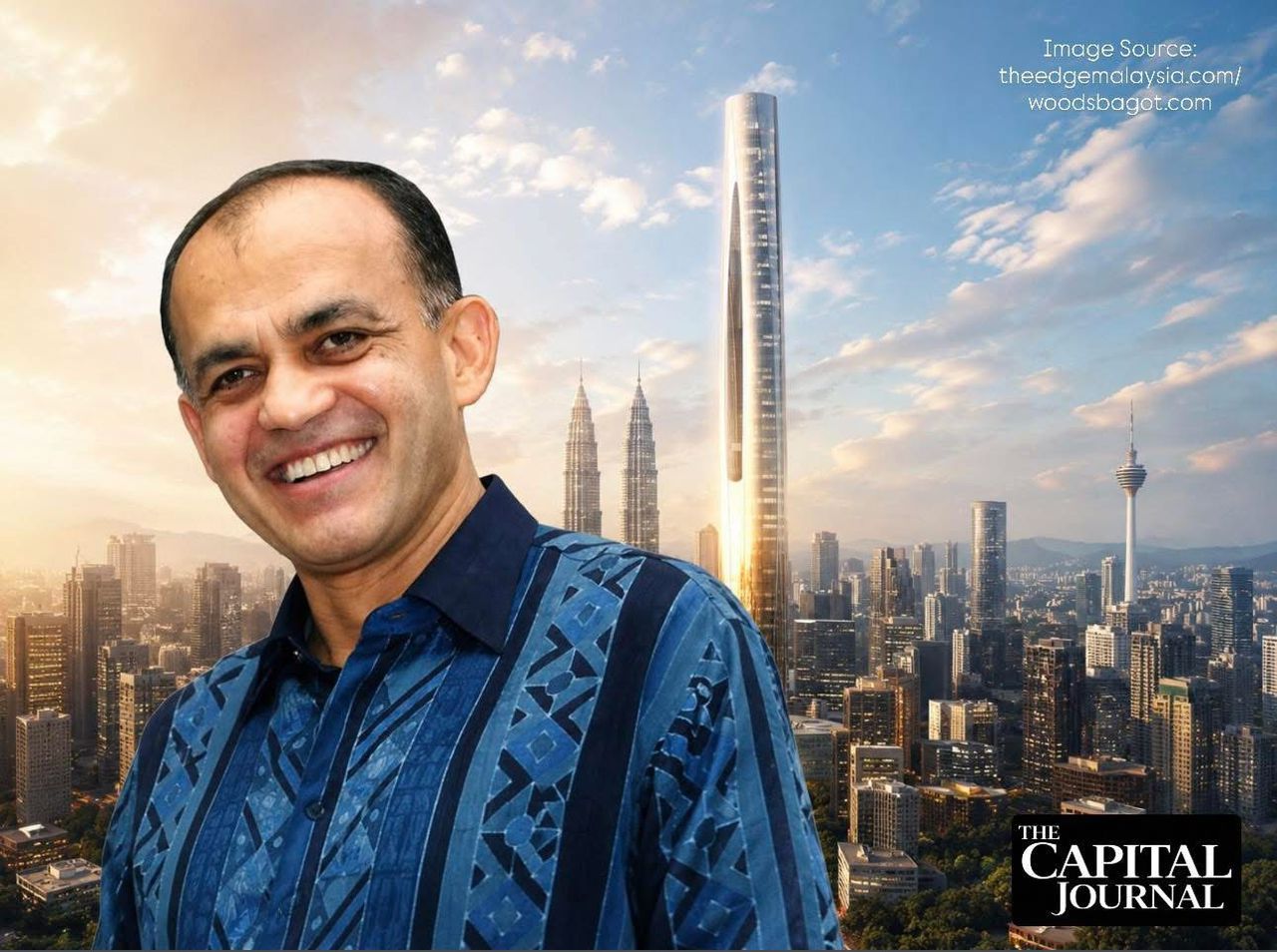
In 2011, Tradewinds officially unveiled plans for Tradewinds Square, immediately triggering intense discussion across Malaysia’s property and financial sectors. Early architectural concepts revealed a mixed use development heavily inspired by Islamic geometric motifs and biomimicry design principles. The project’s centrepiece was reportedly planned at a height of approximately 775 metres, significantly taller than the eventual 689 metre Merdeka 118 tower. Had the project proceeded according to the original proposal, it would have become the world’s second tallest building behind Burj Khalifa.
In 2011, the proposal intensified competition surrounding Kuala Lumpur’s skyline transformation during an era dominated by mega projects and landmark towers. Tradewinds subsequently initiated demolition approval processes for Crowne Plaza Mutiara and Kompleks Antarabangsa in preparation for redevelopment.
In 2012, Syed Mokhtar expanded the group’s ambitions further by announcing plans for the world’s first Harrods Hotel between Jalan Raja Chulan and Jalan Conlay. The RM2 billion development aimed to position Kuala Lumpur directly within the global ultra luxury hospitality market. Notably, the proposed Harrods Hotel site later evolved into the area now occupied by Pavilion Square under Pavilion Group. During the same year, demolition works on the older buildings were fully completed, marking the physical beginning of Tradewinds Square’s redevelopment phase.
In 2013, Tradewinds Corp announced its privatisation and delisting from Bursa Malaysia. The move represented a strategic restructuring exercise designed to provide greater flexibility for long gestation developments requiring substantial long term capital commitments. By moving away from public market reporting pressures, the group gained the ability to adjust project timelines and financing structures more discreetly.
In 2014, Azhar Abdul Hamid assumed the role of managing director within the group after previously serving as chief executive of MRT Corp. Known for taking responsibility following MRT construction incidents, Azhar carried a reputation for strong corporate discipline and operational professionalism. After joining Tradewinds, he reportedly advised management to slow the project in light of worsening office oversupply conditions within Kuala Lumpur.
In 2015, Tradewinds formally introduced a five year transformation strategy. Azhar publicly acknowledged that Malaysia had not yet matured into a fully developed international financial centre capable of immediately supporting a 775 metre mega tower without risking financial imbalance. As a result, Tradewinds Square entered a prolonged land banking phase while the group redirected its focus towards stable cash flow generating hospitality operations.
In recent years, the Tradewinds Square site has remained largely undeveloped despite its strategic location along Jalan Sultan Ismail. However, the land itself has appreciated substantially in value over time. Meanwhile, Tradewinds continues maintaining a portfolio of hospitality assets including Hilton Petaling Jaya and The Danna Langkawi. The group’s cautious positioning reflects a defensive capital preservation strategy focused on liquidity, recurring income, and timing discipline.
The story of Tradewinds Square demonstrated that sometimes the most disciplined corporate decision is choosing not to build. During an era when developers aggressively competed to dominate Kuala Lumpur’s skyline, Tradewinds recognised the risks of forcing a megaproject into an unfavourable market environment. By delaying construction despite already controlling a prime development site, the group prioritised long term balance sheet protection over prestige driven expansion. In many ways, the undeveloped land itself became a strategic asset, preserving optionality and liquidity while avoiding the financial strain that often accompanies oversized real estate ambitions.
1.What was Tradewinds Square originally planned to become?
Tradewinds Square was planned as a massive mixed use development featuring a proposed 775 metre tower in Kuala Lumpur.
2.Why was Tradewinds Square significant?
If completed according to its original proposal, the tower would have become the world’s second tallest building after Burj Khalifa.
3.Why did Tradewinds Corp privatise itself in 2013?
The privatisation allowed the group to pursue long term restructuring and development planning without public market pressure.
4.Why was the project eventually slowed down?
Management became increasingly concerned about Kuala Lumpur’s office oversupply and broader market sustainability.
5.What does the Tradewinds Square story represent today?
The project symbolises disciplined capital management and the importance of timing within large scale property development cycles.
Share this post :