Timeline | Description |
1993 | Tan Sri Ting Pek Khiing launched the Plaza Rakyat project after his Langkawi success, positioning it as a major integrated development in Kuala Lumpur. |
1997 | The Asian Financial Crisis caused currency collapse and credit tightening, forcing the project to halt after partial construction. |
2014 | Kuala Lumpur City Hall repaid MYR150 million in debt and reclaimed ownership of the project land. |
2015 | Debao Property and local partners acquired the project, but ownership shifted after equity restructuring. |
2019 to 2020 | Payment conditions tied to approvals created a deadlock, further worsened by the pandemic, halting progress. |
2023 | Structural assessments revealed severe deterioration, making restoration economically unviable compared to rebuilding. |
Context
In the early 1990s, Malaysia’s property sector was defined by ambition, scale, and confidence. Few projects captured that spirit more than Plaza Rakyat, a development once envisioned as a transformative urban hub in Kuala Lumpur. Today, it stands as one of the most enduring symbols of stalled ambition in the country’s real estate history.
Deep Dive
In 1993, Tan Sri Ting Pek Khiing, a Sarawak timber tycoon, reached the height of his influence following the rapid completion of a landmark hotel project in Langkawi. Riding on strong market credibility, he introduced Plaza Rakyat as a flagship integrated development under Wembley Industries Holdings Bhd.
In 1993, the project was strategically positioned between Petaling Street and Bukit Bintang, two of Kuala Lumpur’s most significant commercial zones. It was designed to bridge heritage commerce with modern retail activity while integrating traffic from Pudu Sentral, making it a central urban node.
In 1993, the master plan outlined a 79-storey office tower, a hotel, and what was projected to be the largest shopping complex in Malaysia. Financing was secured through a banking consortium under Plaza Rakyat Sdn Bhd, reflecting strong institutional confidence in the project.
In 1997, the Asian Financial Crisis disrupted the foundation of Malaysia’s property boom. The sharp depreciation of the ringgit led to a surge in construction costs while tightening credit conditions severely constrained liquidity.
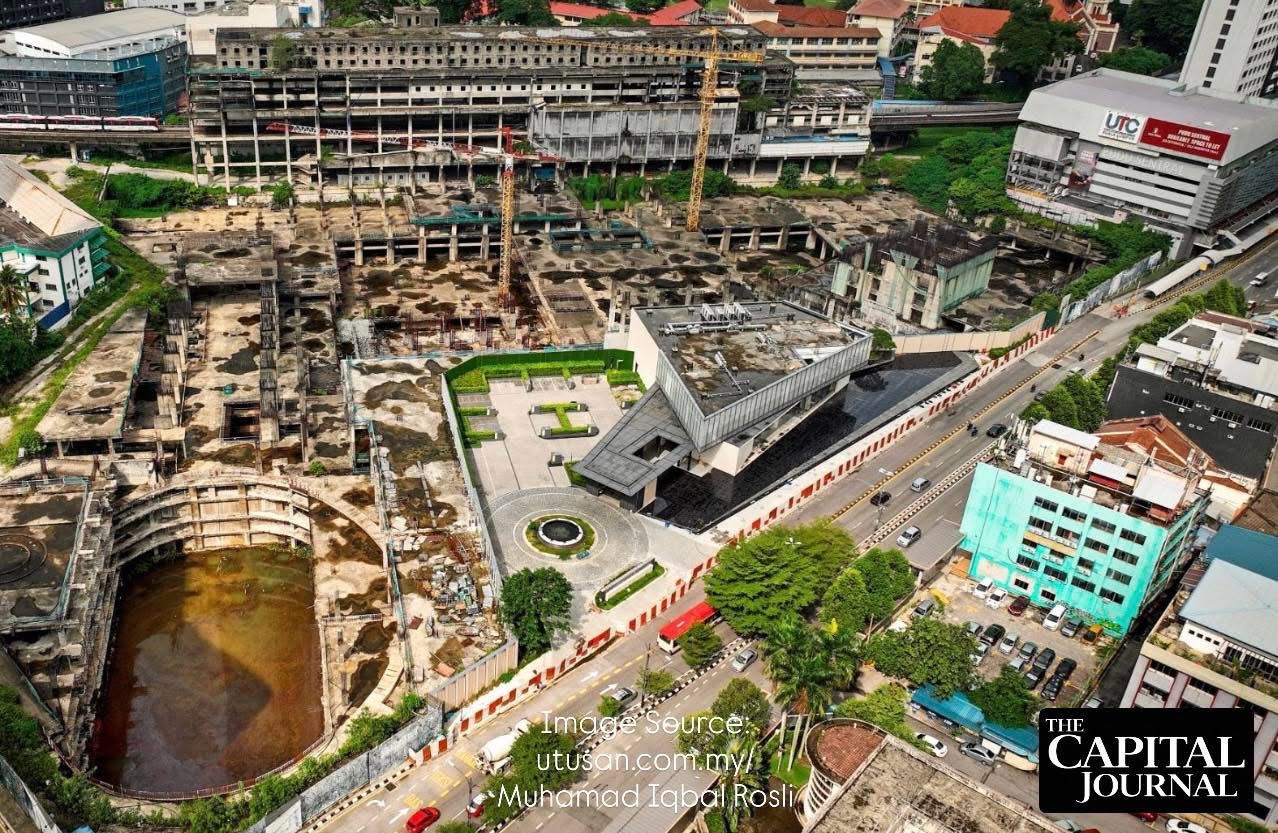
In 1997, construction at Plaza Rakyat came to an abrupt halt after only the foundation and parts of the podium were completed. The site deteriorated into a waterlogged excavation, raising public health concerns and becoming a financial burden for hundreds of small investors.
From 1997 to 2014, the project remained trapped in prolonged debt disputes and asset devaluation. Investors who had committed their life savings were left with unenforceable contracts, while the site itself became a visible scar within the city centre.
In 2014, Kuala Lumpur City Hall took decisive action by settling MYR150 million in outstanding loans and reclaiming ownership of the land. The authority then initiated an open tender to identify a financially capable developer to revive the project.
In 2015, Singapore-listed Debao Property partnered with local stakeholders to acquire Plaza Rakyat through a consortium known as Profit Consortium. The move was initially seen as a turning point in the project’s recovery.
In 2015, the ownership structure quickly became unstable as Debao Property faced financial pressures and began divesting its stake. Guangzhou Xu Zhuo Industrial Management Co Ltd acquired a 43% stake for a relatively small sum, effectively gaining control, while Debao Property’s interest was diluted to 19%.
In 2019, the consortium made an initial payment of MYR70 million and committed to a second tranche of the same amount. However, the remaining MYR490 million was tied to phased payments contingent upon planning approvals.
From 2019 to 2020, this structure created a strategic deadlock. Developers were reluctant to commit capital without guaranteed approvals, while Kuala Lumpur City Hall was cautious about granting approvals without financial certainty.
From 2020 to 2022, the Covid 19 pandemic further compounded the stalemate, effectively freezing all progress and reinforcing the uncertainty surrounding the project’s future.
In 2023, engineering assessments revealed that the exposed concrete structure had suffered extensive deterioration after more than 25 years of exposure to the elements. Corrosion of reinforcement and structural fatigue significantly increased rehabilitation costs.
In 2023, experts concluded that reinforcing the existing structure could be more expensive than demolishing and rebuilding. However, demolition would require substantial cost and necessitate a complete redesign, including the removal of previously planned integration with Pudu Sentral.
A City That Moved On
In recent years, Kuala Lumpur has undergone a profound transformation. New developments have reshaped the city’s skyline and economic focus, leaving Plaza Rakyat increasingly out of sync with its surroundings.
The rise of Merdeka 118 has introduced a new global landmark, redefining the city’s architectural identity. At the same time, Tun Razak Exchange has established itself as the country’s financial core, attracting international capital and institutions.
Meanwhile, LaLaport Bukit Bintang City Centre and Zepp Kuala Lumpur have redefined the former Pudu Prison site, leveraging youth culture and experiential retail to revitalise the area.
Against this backdrop, Plaza Rakyat remains physically and symbolically disconnected from Kuala Lumpur’s current growth narrative.
Key Takeaway
Plaza Rakyat reflects more than a delayed construction project. It illustrates how timing, financial structure, and regulatory alignment can determine the fate of large scale developments. While the city evolved, the project remained locked in structural, financial, and strategic constraints. What it ultimately lost was not just momentum, but relevance within a rapidly changing urban landscape.
FAQs
1. Why did Plaza Rakyat fail initially?
The project collapsed during the Asian Financial Crisis due to rising costs and restricted credit, which disrupted cash flow.
2. What role did Kuala Lumpur City Hall play?
It repaid outstanding debts in 2014 and reclaimed the land to facilitate redevelopment.
3. Why did the 2015 revival effort struggle?
Ownership instability and financial restructuring weakened execution capability and delayed progress.
4. What caused the project deadlock after 2019?
Payment obligations were tied to planning approvals, creating mutual hesitation between developers and authorities.
5. Why is the project difficult to revive today?
Structural deterioration makes restoration costly, while demolition would require significant capital and redesign.