Timeline | Description |
2011 to 2012 | True Renaissance Development Sdn Bhd secured development rights via joint venture with PMSB and launched Empire Remix. The project relied on pre sales and high density SOHO units to drive cash flow. |
2019 | Construction halted after funding collapsed and the joint venture was terminated. Remix 1 stopped at under 30% completion, leaving more than 2,500 buyers affected. |
2019 to 2023 | HCK Capital Group Berhad acquired Remix 2 and redeveloped it into Edumetro with SEGi College as anchor tenant. The project shifted from sales to operational model. |
2022 to 2023 | HCK proposed restructuring of Remix 1 via Corporate Voluntary Arrangement with 90.7% creditor support. The plan was later overturned by the Kuala Lumpur High Court. |
2024 to 2026 | True Renaissance entered liquidation and HCK restructured agreements directly with PMSB. Construction resumed with new contractors and financing, targeting phased completion over six to seven years. |
Context
Malaysia property sector has periodically faced the challenge of abandoned developments, where financial failure intersects with legal complexity. These projects test not only capital strength, but also the ability of the system to realign stakeholders and restore viability. The Empire Remix case illustrates how revival depends less on construction capability and more on restructuring pathways that can reconcile competing interests.
Deep Dive
In 2011, True Renaissance Development Sdn Bhd entered into a joint venture with PMSB to develop Empire Remix in Subang USJ1. The land remained under the ownership of PMSB, while development rights were granted to the developer. This structure introduced layered risk, as failure would trigger not only financial loss but also contractual disputes over rights and control.
In 2012, Empire Remix was launched as a high density mixed development comprising SOHO units and retail space. The project adopted a pre sales driven model, where buyer payments funded construction. While this approach enabled rapid scaling during favourable market conditions, it depended entirely on uninterrupted cash flow.
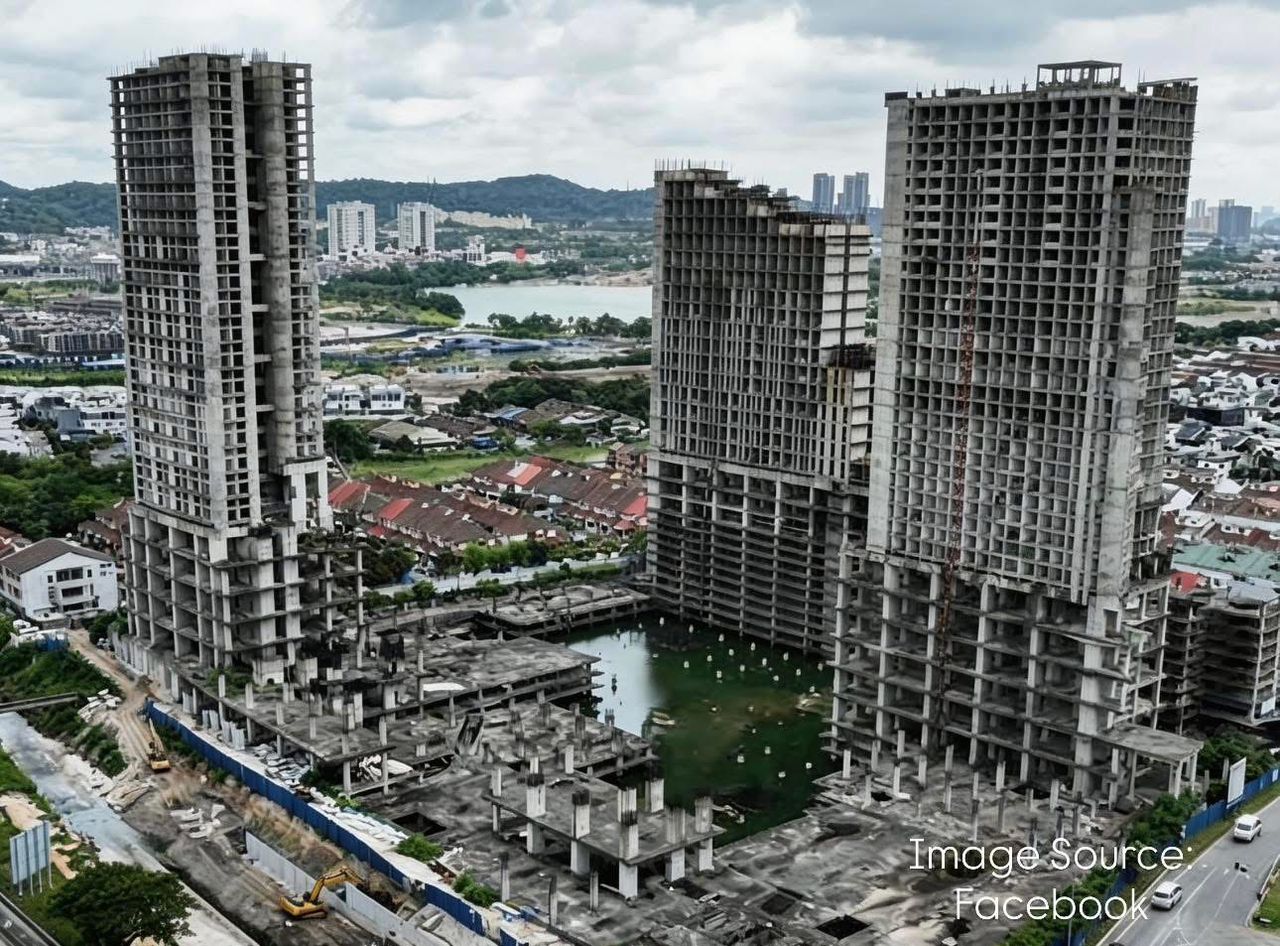
In 2019, the project funding structure collapsed. The joint venture agreement was terminated in January after the developer failed to meet obligations. Construction of Remix 1 halted at below 30% completion, leaving only partial structures including basement works and incomplete towers. More than 2,500 buyers, who had collectively paid approximately RM500 million at prices ranging from RM450 to RM550 per square foot, were left servicing loans without delivery.
In 2019, a different outcome emerged for Remix 2. HCK Capital Group Berhad took over the parcel and appointed a new contractor to reposition the project as Edumetro. The development was restructured around an education led model, with SEGi College serving as the anchor tenant. Residential units were repurposed into student accommodation, while commercial components were aligned to campus demand. This marked a shift from transactional sales to recurring operational income.
In 2023, Edumetro was completed and operational, demonstrating that a stalled project could be revived under a revised framework. However, Remix 1 remained inactive, constrained by fragmented creditor interests and unresolved legal relationships. The issue extended beyond funding, as no single party could align all stakeholders to proceed.
From 2019 to 2022, Remix 1 remained in limbo, with no viable takeover despite market interest. Legal entanglements and dispersed claims prevented consolidation of control. The project became emblematic of the structural barriers to reviving abandoned developments.
In 2022, HCK and PMSB entered into a new joint venture arrangement, supported by a proposed Corporate Voluntary Arrangement. The restructuring secured 90.7% creditor approval, allowing for deferment of claims in exchange for project continuation. HCK committed to inject approximately RM900 million and rebranded the project as Subang Sentral, while maintaining original purchase terms for existing buyers.
In 2023, opposition from a minority of buyers led to legal challenges, particularly over claims related to Developer Interest Bearing Scheme obligations and compensation for delays. In July, the Kuala Lumpur High Court ruled that the restructuring mechanism was not applicable to abandoned housing projects, effectively nullifying the plan. This decision removed the legal basis for HCK takeover and halted progress once again.
In 2024, True Renaissance Development Sdn Bhd entered liquidation, and a court order formalised the winding up process. This removed the original developer from the structure, clearing a key obstacle but not automatically restarting the project.
In 2025, HCK re engaged with the liquidator and PMSB to establish a revised development framework. By preserving existing sale and purchase agreements, the project regained legal continuity. Claims related to interest subsidies and compensation were redirected towards the original developer, separating legacy liabilities from future execution.
In 2026, construction formally resumed. HCK appointed Binastra Corporation Berhad as main contractor, with works covering both existing structures and new tower additions. The total development cost is expected to exceed RM1 billion, implemented across four phases. Initial phases prioritise completion of units for original buyers, with delivery targeted within three to four years and full completion over six to seven years. Financing support includes approximately RM250 million in bridging facilities from United Overseas Bank, alongside internal capital commitments exceeding RM450 million.
Key Takeaway
The Empire Remix case underscores that reviving abandoned property projects is not primarily a construction challenge, but a coordination problem involving legal alignment, financial restructuring and stakeholder consensus. Successful outcomes depend on whether a viable framework can be established to balance competing claims while restoring execution certainty. Without that alignment, even well located projects can remain stalled indefinitely.
FAQs
1. Why did Empire Remix fail initially?
The project relied heavily on pre sales funding, and when cash flow stopped, construction could not continue.
2. What is the difference between Remix 1 and Remix 2 outcomes?
Remix 2 was restructured early with a new concept and anchor tenant, while Remix 1 was delayed by legal and creditor complications.
3. What role did HCK play in the project revival?
HCK restructured the development model, injected capital and led negotiations to restart construction.
4. Why was the restructuring plan rejected in court?
The court ruled that the proposed mechanism was not applicable to abandoned housing projects.
5. What is required to revive abandoned property developments?
Alignment among stakeholders, clear legal structure and sufficient funding are critical to restarting stalled projects.
Share this post :