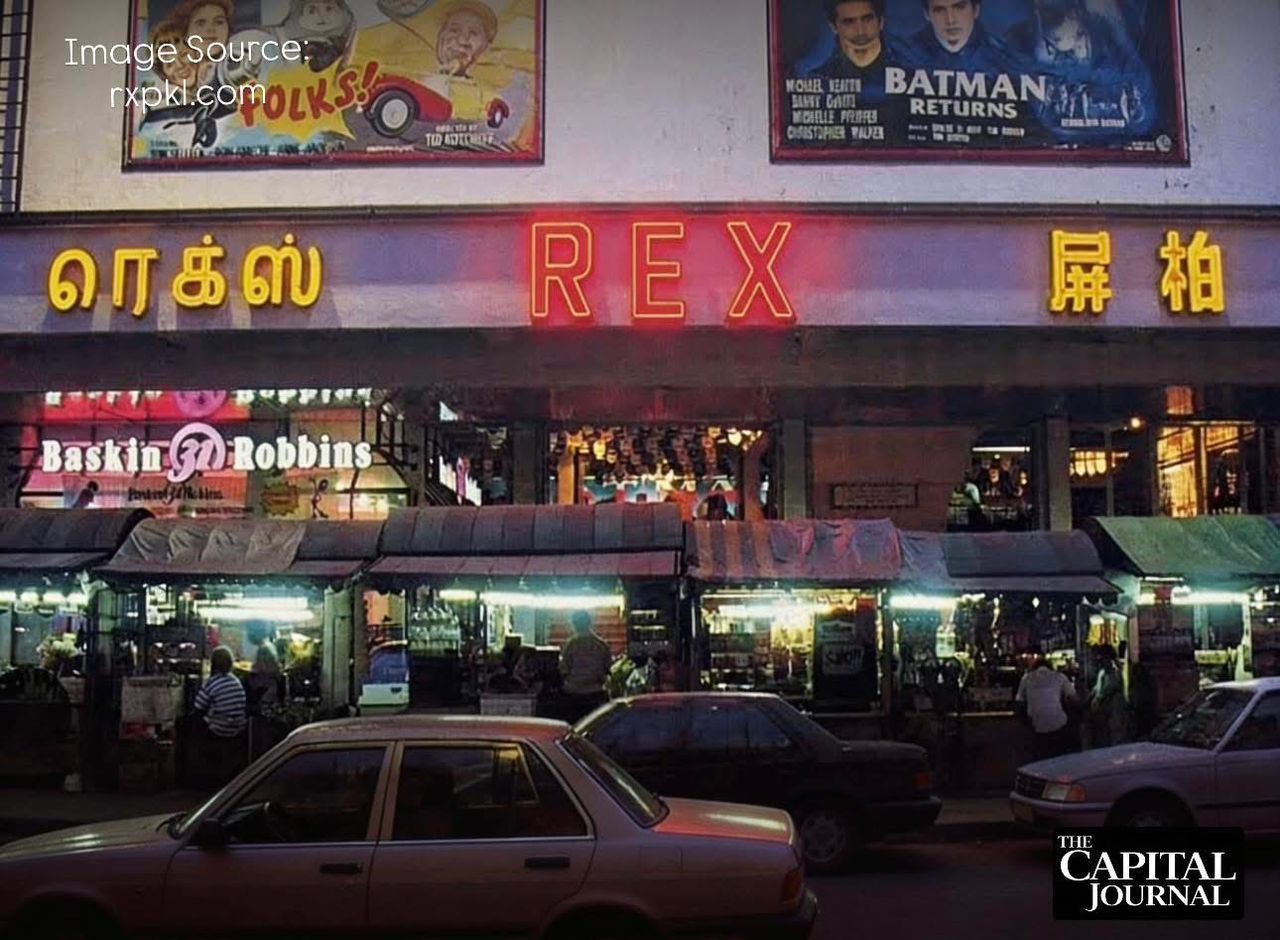
Timeline | Description |
1947 | REX Cinema opened as one of Kuala Lumpur’s most advanced theatres under the vision of Cheong Yoke Choy. |
1972 to 1976 | A fire destroys the building, followed by reconstruction led by Golden Screen Cinemas with expanded capacity. |
1993 to 1995 | Technological upgrades introduce digital sound and computerised ticketing, marking its peak era. |
2002 | A second fire forces permanent closure, leaving the site abandoned for over a decade. |
2018 to 2023 | Adaptive reuse transforms the structure into REXKL, anchored by BookXcess and RXP digital gallery. |
Context
Today known as REXKL, a cultural landmark in Kuala Lumpur, the building once stood as one of the city’s most prestigious cinemas. Beneath its maze like bookshelves lies a sloped floor that once carried thousands of cinema goers into its screening halls. Beyond its architectural evolution, the site reflects nearly a century of commercial strategy, urban decline, and eventual reinvention within the historic Petaling Street district.
Its origins are closely tied to Kwong Yik Bank, one of the earliest Chinese owned financial institutions in Malaya, illustrating how capital once extended beyond banking into strategic real estate control.
Deep Dive
In 1947, REX Cinema was officially opened, designed by architect James Robert Vethavanam. Backed by Cheong Yoke Choy, the project was not merely an entertainment venture. It formed part of a broader strategy to secure prime urban land and reinforce financial influence through physical assets. As one of the earliest air conditioned cinemas in the country, it quickly became both a social hub and a commercial anchor within the city centre.
In 1972, a devastating fire reduced the cinema to ashes, wiping out its infrastructure and weakening investor confidence. By 1976, Golden Screen Cinemas stepped in to redevelop the site. The rebuilt structure was engineered for maximum commercial efficiency, increasing seating capacity to approximately 1,100 and introducing upper tier seating, a rarity at the time. This repositioning allowed the cinema to dominate film distribution during Malaysia’s cinematic golden era.
In 1993, the cinema reached a technological milestone with the introduction of DTS digital sound, coinciding with the release of Jurassic Park. This marked its status as a leading venue in exhibition technology. In 1995, further upgrades included computerised ticketing systems, an effort to sustain competitiveness amid changing industry dynamics. However, the rise of multi screen cinema complexes gradually eroded the viability of single hall theatres.
In 2002, a second fire struck, this time dealing a fatal blow. The cinema ceased operations under mounting financial losses, and the building entered a prolonged period of abandonment. For over 15 years, it stood as a decaying relic within Petaling Street, reflecting the broader stagnation of the surrounding district.
In 2018, a turning point emerged when architects Shin Chang and Shin Tseng led an adaptive reuse initiative. Instead of demolition, the team revitalised the 60,000 square foot structure by preserving its core architectural elements while reimagining its commercial function.
In 2021, BookXcess became the anchor tenant, transforming the former cinema hall into a multi level bookstore. The original sloped flooring was retained and repurposed into layered shelving, creating a visually distinctive retail environment. This approach preserved historical integrity while introducing a new commercial identity.
In 2023, the launch of REXPERIENCE (RXP) marked the building’s evolution into a content driven space. The former main hall was converted into an immersive digital art gallery spanning 8,800 square feet. Static walls became dynamic projection surfaces, enabling flexible programming and repeated monetisation through digital exhibitions. This shift represented a transition from fixed asset utilisation to scalable content based revenue generation.
Key Takeaway
The transformation of REXKL demonstrates how legacy urban assets can be revitalised through adaptive reuse and digital integration, turning historical structures into sustainable engines of cultural and commercial value.
FAQs
1. What was REXKL originally?
It was originally REX Cinema, one of Kuala Lumpur’s most advanced and prestigious theatres when it opened in 1947.
2. Who was behind its early development?
The project was backed by Cheong Yoke Choy, founder of Kwong Yik Bank, as part of a broader strategy to control key urban assets.
3. Why did the cinema decline?
The rise of multi screen cinemas and two major fires, particularly in 2002, led to its permanent closure.
4. What is REXKL today?
It is a cultural and retail hub featuring BookXcess bookstore and REXPERIENCE, an immersive digital art space.
5. Why is REXKL significant to Petaling Street?
Its revival has helped reposition the district as a cultural destination, drawing new foot traffic and restoring economic relevance.