Timeline | Description |
2000 | ViTrox Technology was founded with initial capital of RM20000 by three engineers. |
2004 to 2009 | Company rebranded as ViTrox Corporation and transitioned from MESDAQ to Main Market listing. |
2010 to 2020 | Expanded globally, serving semiconductor, EMS, and industrial clients across multiple regions. |
2022 to 2023 | Launched Industry 4.0 solutions and established ViTrox College to develop talent pipeline. |
2024 to 2026 | Achieved market capitalisation of around RM8 billion with global presence in over 20 countries. |
Context
A recent viral proposal involving Perry Kuan and Jia Yi has drawn unexpected attention to a company rarely in the public spotlight.
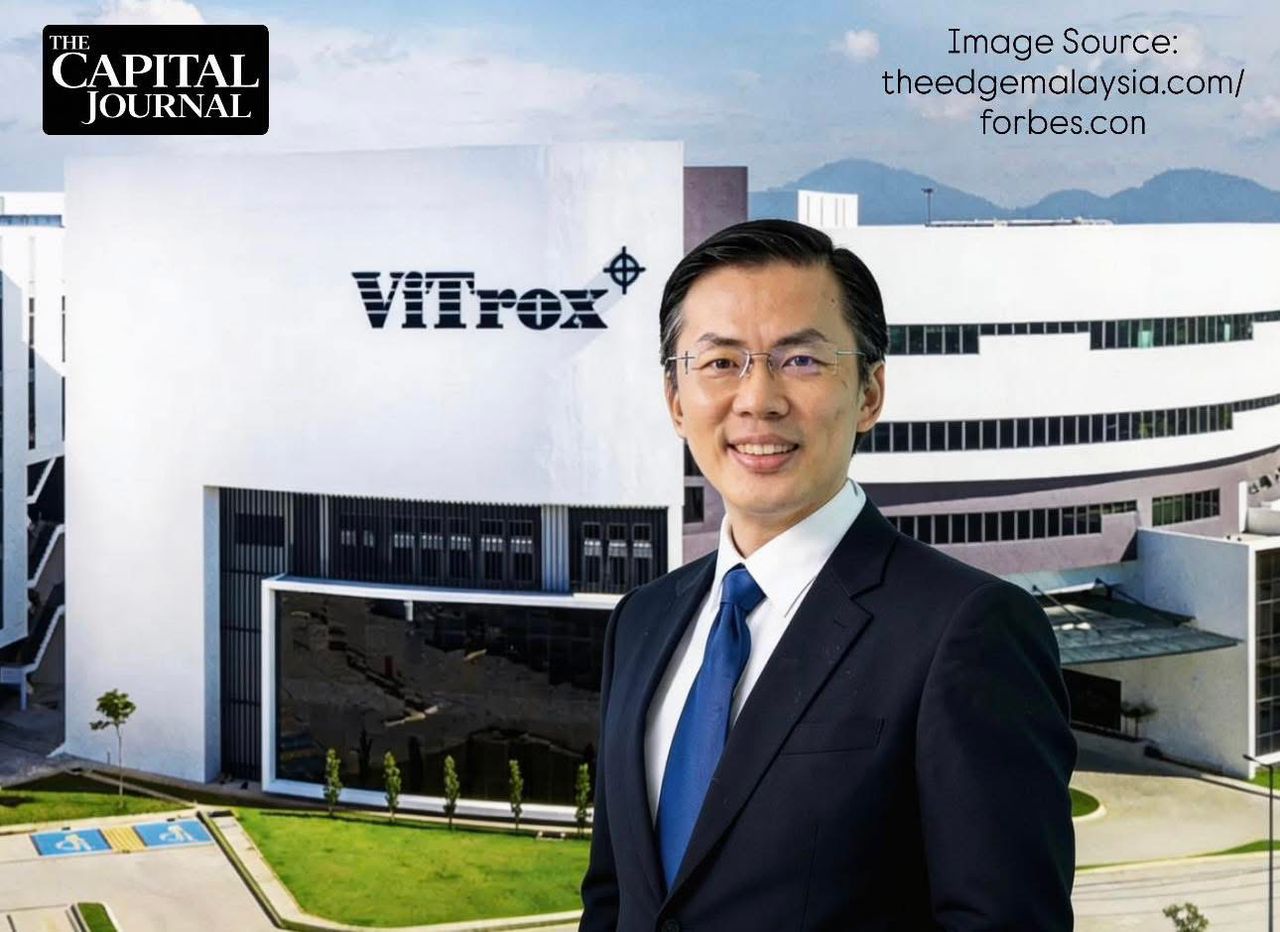
That company is ViTrox Corporation Berhad, a Penang based technology firm that plays a critical role in ensuring the quality and reliability of semiconductor and electronic products worldwide.
Despite its low profile, ViTrox has built a position as a key enabler in the global electronics manufacturing ecosystem.
Deep Dive
In the early 1990s, Chu Jenn Weng developed expertise in machine vision while studying at Universiti Sains Malaysia. His academic training in electronic engineering and image processing laid the foundation for a specialised field that replaces human inspection with algorithm driven analysis.
In 1993, he began his career at Hewlett Packard in Penang. Over six years, exposure to global manufacturing practices, including visits to the United States, shaped his ambition to build a high technology company in Malaysia.
In 2000, ViTrox Corporation Berhad was established with initial capital of RM20000. The founding team included Chu Jenn Weng, Low Kian Huat, and Ooi Eng Leong.
Each founder assumed distinct roles, covering product development, system integration, and machine vision engineering. Within six months, the team delivered its first product, a two dimensional vision system designed to detect defects in semiconductor markings and lead structures.
This early success validated the commercial potential of machine vision in electronics manufacturing.
In 2004, the company rebranded as ViTrox Corporation, marking its transition from a small engineering outfit into a comprehensive solutions provider. Its offerings expanded to include machine vision systems and automated board inspection technologies.
These systems serve a critical function. They ensure that defects in semiconductor packaging and printed circuit boards are identified before products reach end users, reducing failure rates and improving manufacturing yield.
In 2005, ViTrox was listed on Bursa Malaysia’s MESDAQ market, providing access to capital for expansion. By 2009, it had transferred to the Main Market, reflecting its growing scale and maturity.
From 2010 onwards, the company expanded globally. Its customer base includes outsourced semiconductor assembly and test providers such as Inari Amertron and ASE Group, as well as electronics manufacturing services firms such as Foxconn and Flex.
These clients rely on ViTrox systems to detect microscopic defects in chips and circuit boards. In industries such as automotive electronics and telecommunications, where reliability is critical, such inspection capabilities are essential.
From 2022 onwards, ViTrox aligned itself with Industry 4.0 trends. It introduced V ONE, a platform that connects inspection systems across production lines, enabling predictive maintenance and data driven optimisation.
In 2023, the group established ViTrox College in Batu Kawan, Penang. Through work based learning programmes, the institution integrates academic training with real manufacturing environments, addressing talent shortages in the semiconductor sector.
By 2024, Chu Jenn Weng was recognised in the Forbes Malaysia rich list, with an estimated net worth of USD430 million. Despite this, the company’s leadership has maintained a disciplined and modest corporate culture, including commitments to allocate a portion of profits to education and community initiatives.
As of 2026, ViTrox Corporation Berhad has achieved a market capitalisation of approximately RM8 billion, with operations spanning more than 20 countries.
Key Takeaway
ViTrox’s rise underscores the importance of specialised technology within global supply chains. Rather than competing in mass production, the company has positioned itself at a critical control point, quality assurance.
By mastering machine vision and inspection systems, ViTrox Corporation Berhad has become indispensable to manufacturers seeking near zero defect production.
Its trajectory highlights how niche technological capabilities can translate into global relevance and sustained value creation.
FAQs
1. What does ViTrox do?
It develops machine vision and inspection systems for semiconductor and electronics manufacturing.
2. Why is its technology important?
It ensures product quality by detecting defects that are invisible to the human eye.
3. Who are its main customers?
Semiconductor companies, electronics manufacturers, and industrial producers.
4. How did ViTrox grow globally?
Through continuous innovation and expansion into major manufacturing hubs.
5. What is its long term strategy?
To integrate inspection systems with Industry 4.0 technologies and strengthen talent development.