Timeline | Description |
1969 to 1973 | Lim Kah Ngam Group established its hotel arm and opened Hotel Equatorial Kuala Lumpur. |
1975 | The hotel gained global attention during the Muhammad Ali and Joe Bugner boxing event. |
2008 | Corporate restructuring led to separation of Equatorial brand from listed assets. |
2012 to 2019 | Original hotel demolished and redeveloped into EQ Kuala Lumpur and Equatorial Plaza. |
2025 to 2028 | EQ strengthens regional presence with awards and expansion into Penang and Phuket. |
Context
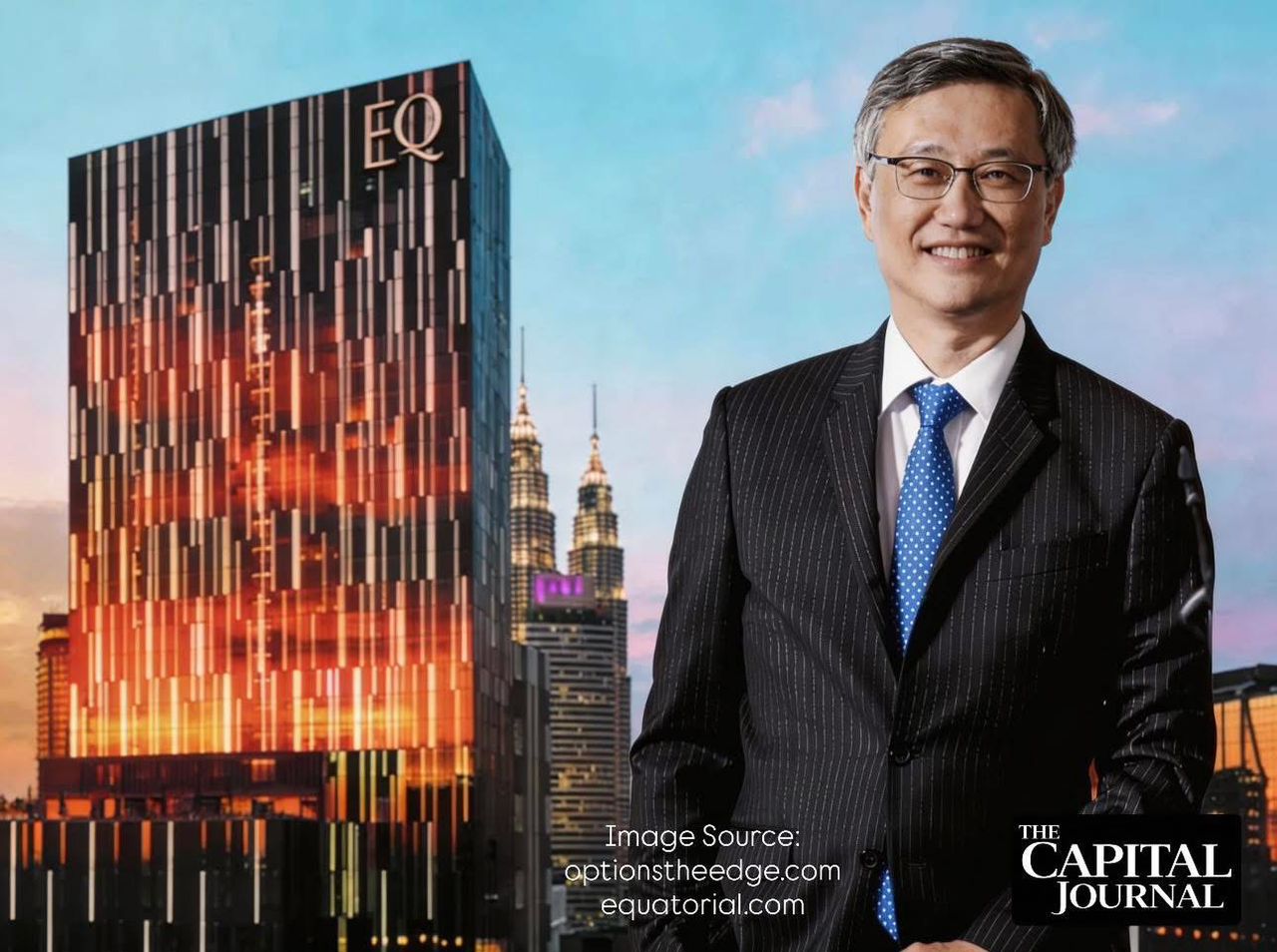
In recent years, EQ Kuala Lumpur has re established itself as one of the most prominent venues for corporate events and capital market activities in Malaysia.
From prospectus launches to high profile gatherings, the hotel has become synonymous with prestige. By night, its rooftop destination Sky51 offers panoramic views of Petronas Twin Towers and Kuala Lumpur Tower, reinforcing its position at the heart of the city’s modern skyline.
This resurgence is the result of a decisive seven year redevelopment that transformed a legacy property into a contemporary integrated asset.
Deep Dive
In 1961, the foundation of the business was laid when the Lim family established Lim Kah Ngam Group. Originating from construction, the group developed strong capabilities in cost management and spatial optimisation.
In 1969, the group formalised its hotel operations, focusing on providing quality accommodation in prime locations. This marked its entry into the hospitality sector.
In 1971, Kuala Lumpur’s Golden Triangle began to take shape, defined by key commercial corridors. During this period, construction of Hotel Equatorial Kuala Lumpur progressed rapidly.
In 1973, the hotel officially opened with approximately 300 rooms. At the time, the surrounding landscape was markedly different. The site near today’s KLCC area was still occupied by the Royal Selangor Turf Club, and the iconic Petronas Twin Towers had yet to be conceived.
As one of Malaysia’s earliest modern five star hotels, Hotel Equatorial Kuala Lumpur introduced features such as electronic locking systems, setting new standards in hospitality and quickly attracting business and political elites.
In 1975, the hotel gained international exposure during the heavyweight boxing event featuring Muhammad Ali and Joe Bugner. While Ali stayed elsewhere, Bugner and the accompanying global media contingent were hosted at the hotel, showcasing its service capabilities on an international stage.
From 1984 onwards, the group pursued regional expansion. Lim Kah Ngam Limited was listed on the Singapore Exchange, and operations extended to Penang, Vietnam, and Malacca. Strategic partnerships, including collaboration with Sime Darby, supported asset growth while retaining brand management control.
In 2008, corporate restructuring reshaped the group. The listed entity was rebranded as HL Global Enterprises. In response, the Lim family separated the Equatorial brand from heavy asset ownership, forming a privately controlled Equatorial Group to retain brand integrity.
In 2012, a pivotal decision was made. After nearly four decades of operation, the original Hotel Equatorial Kuala Lumpur no longer met modern building standards. Rather than pursue incremental upgrades, the group chose to demolish the structure entirely, committing approximately RM400 million to redevelopment.
This marked a rare instance of a family controlled group dismantling a flagship asset at its peak to ensure long term relevance.
From 2012 to 2019, the site underwent complete transformation. The result was EQ Kuala Lumpur and the adjacent Equatorial Plaza, a Grade A office tower.
In 2019, a significant portion of the office space, approximately 460000 square feet, was sold to Great Eastern Life for between RM450 million and RM500 million. The transaction unlocked capital while securing a roster of high profile tenants, including multinational corporations and financial institutions.
From 2019 onwards, EQ Kuala Lumpur positioned itself as a premium hospitality and corporate destination. Its integration of hotel, office, and lifestyle components reflects a shift towards mixed use urban assets.
In 2025, the hotel achieved sustained industry recognition, ranking as Malaysia’s top city hotel in the Travel and Leisure Asia Pacific awards for four consecutive years. This reinforced its repositioning success.
Looking ahead, the group continues to expand. Renovation of its Penang property is underway, with reopening targeted for 2027. In parallel, plans for a new development in Phuket are scheduled for launch in 2028.
Key Takeaway
The transformation of EQ Kuala Lumpur illustrates a fundamental principle in long term asset management. Legacy alone is insufficient to sustain relevance in a rapidly evolving urban landscape.
By demolishing and rebuilding its flagship property, Equatorial Group demonstrated a willingness to sacrifice historical value in pursuit of future competitiveness.
In doing so, it secured a renewed position within Kuala Lumpur’s skyline, standing once again alongside landmarks such as the Petronas Twin Towers as both participant and observer of the city’s continued evolution.
FAQs
1. What was Hotel Equatorial Kuala Lumpur?
It was one of Malaysia’s earliest five star hotels, opened in 1973.
2. Why was the original hotel demolished?
To meet modern building standards and reposition the asset for long term competitiveness.
3. What is EQ Kuala Lumpur today?
A luxury integrated development combining hotel, office, and lifestyle components.
4. How did the group unlock value from redevelopment?
By selling office space while retaining hospitality operations.
5. What is the group’s future direction?
Regional expansion and continued focus on premium hospitality assets.