
Timeline | Description |
1984 to 1988 | Vincent Tan Chee Yioun acquired Berjaya Kawat Berhad and restructured Inter-Pacific Industrial Group Berhad, forming the group’s listed foundation. |
1992 to 1993 | Lottery assets were injected and reorganised into Berjaya Sports Toto Berhad, establishing a strong recurring cash flow base. |
1990 to 2003 | Property platforms Berjaya Land Berhad and Berjaya Assets Berhad expanded, culminating in Berjaya Times Square. |
2007 to 2009 | The group re-entered telecommunications with U Mobile and invested in Redtone Digital Berhad. |
2011 to 2014 | Consumer arms including Berjaya Food Berhad and 7-Eleven Malaysia Holdings Berhad were listed, strengthening recurring income. |
2013 to 2016 | Bermaz Auto Berhad delivered strong earnings growth under favourable market conditions. |
Berjaya Corporation Berhad built one of Malaysia’s most diversified corporate groups through a strategy that combined stable cash generating businesses with expansion into property, telecommunications, and consumer sectors. The model balanced recurring income with capital-intensive investments, allowing the group to scale across multiple industries over several decades. Developments linked to U Mobile have recently renewed attention on this long-standing strategy and its evolution.
In 1984, Vincent Tan Chee Yioun acquired Berjaya Kawat Berhad, marking his entry into Malaysia’s listed corporate space. In 1988, he strengthened control by restructuring Inter-Pacific Industrial Group Berhad, establishing a platform for future expansion.
In 1992, lottery assets were injected into the group’s structure, and in 1993 the business was reorganised into Berjaya Sports Toto Berhad. The gaming segment provided predictable cash flow and low capital requirements, forming the financial backbone for expansion into other sectors.
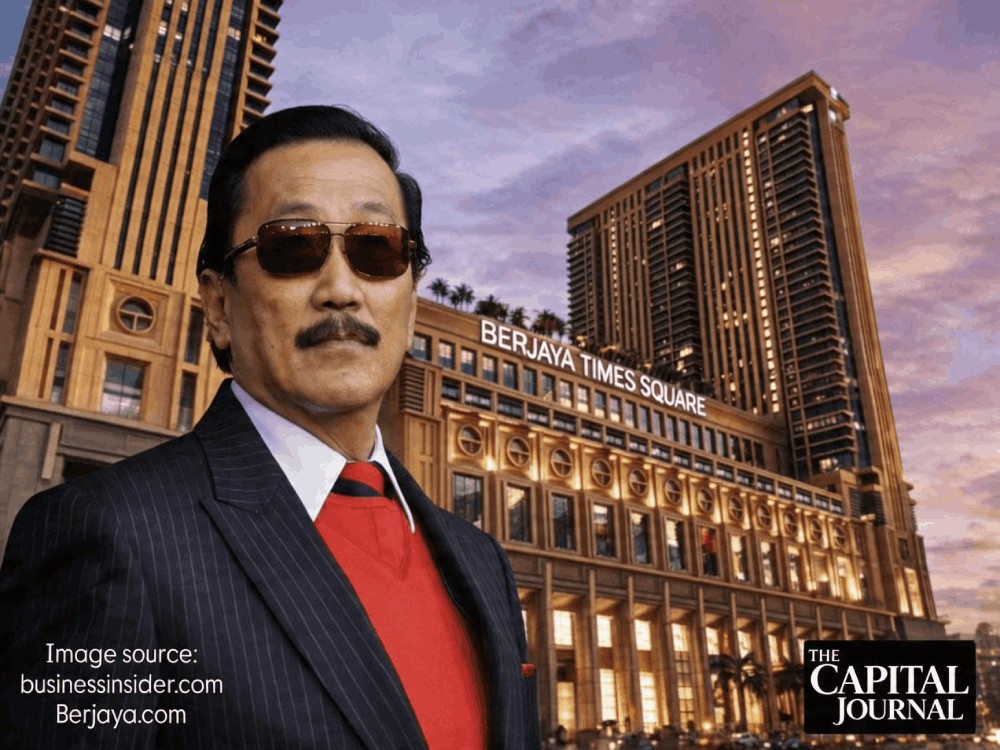
From 1990 to 2003, the group developed a dual property strategy through Berjaya Land Berhad and Berjaya Assets Berhad. This approach culminated in Berjaya Times Square, a large-scale integrated development completed in 2003 that became a defining asset within the portfolio.
In 2007, the group re-entered telecommunications with U Mobile, entering a competitive market dominated by established players. In 2009, its exposure was expanded through an investment in Redtone Digital Berhad, reflecting a broader push into digital infrastructure.
From 2011 to 2014, the group strengthened its consumer segment through the listings of Berjaya Food Berhad and 7-Eleven Malaysia Holdings Berhad. These businesses introduced more stable and recurring income streams while improving investor visibility.
From 2013 to 2016, Bermaz Auto Berhad emerged as a strong performer, benefiting from favourable market conditions and rising demand for vehicles. Its earnings growth positioned it as one of the group’s standout listed entities.
In the later years, the group’s wide network of listed companies reflected an ambitious expansion strategy across multiple industries. However, this complexity contributed to valuation challenges, leading to a shift towards privatisation, divestment, and structural simplification.
Berjaya Corporation Berhad demonstrates a capital allocation model built on combining stable cash flow with expansion into diverse sectors. While this approach enabled rapid growth, increasing structural complexity reduced valuation clarity. The group’s evolution highlights the trade-off between scale and simplicity in long-term corporate strategy.
1.What powered Berjaya’s early expansion?
The recurring cash flow from Berjaya Sports Toto Berhad funded investments across multiple sectors.
2.Why was Berjaya Times Square significant?
It represented a major integrated development and a key milestone in the group’s property strategy.
3.What role did U Mobile play in the group?
It marked the group’s return to telecommunications and a long-term investment in a competitive industry.
4.Why did Berjaya list multiple subsidiaries?
Listings allowed capital raising, improved transparency, and expansion across different business segments.
5.Why did the group later streamline its structure?
Complexity led to valuation discounts, prompting restructuring to improve efficiency and investor clarity.
Share this post :